
When a government says it will ban something, but enforces nothing, who bears the cost?
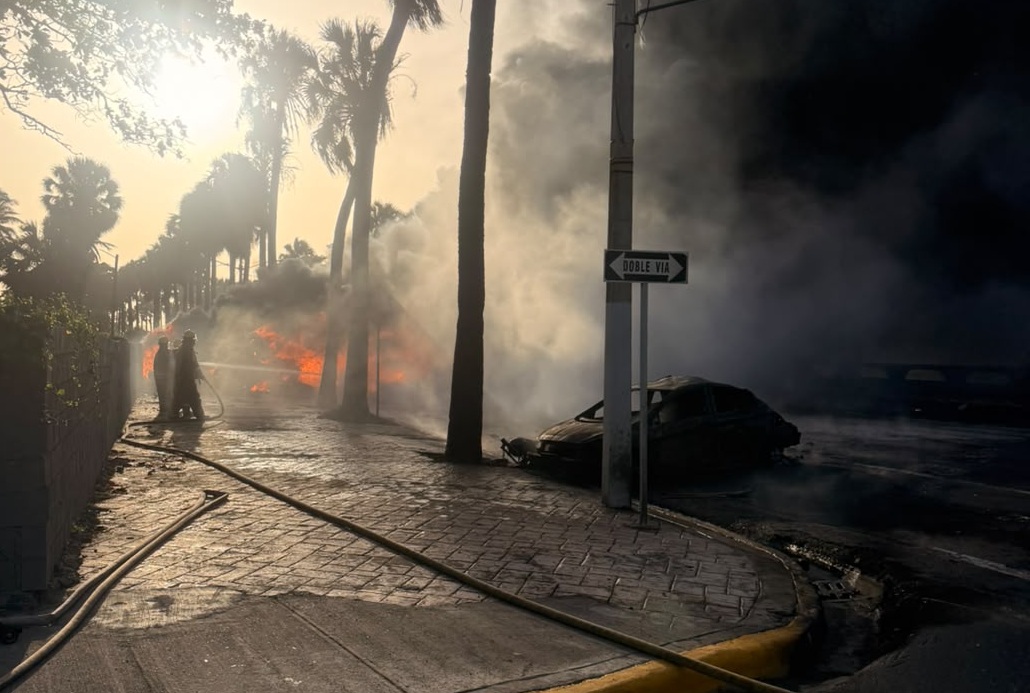
On Monday, August 17, 2026, at approximately 7 AM on George Washington Avenue in Santo Domingo, a diesel tanker carrying 10,000 gallons collided with an SUV near the Sheraton Hotel. The impact tore open the fuel tank. The diesel spilled across the roadway. Within seconds, it ignited.
Two people died. One was the truck driver. The other was Maria Altagracia Mendez de Olivo, 53 years old, known in her neighborhood as Tata. She had run Centro Educativo Imara, a private school, for 25 years. She had three children and a husband waiting to know why she never came home.
What makes this tragedy more than a traffic accident is this: the government had already ordered that truck to never be on that road in the first place.
The Resolution That Wasn’t
On January 30, 2025, the Dominican government issued an official prohibition against heavy trucks on the Malecon. The order was specific. It covered George Washington Avenue from the port of Santo Domingo to the Luperón Avenue distributor. It applied to all vehicles with two or more axles. The permitted alternate route was clearly defined: Kennedy Avenue to Francisco del Rosario Sanchez.
That order was not a suggestion. It was not aspirational language. It was a formal government directive with a date, a scope, and legal standing.
Trucks with special permits could still use the Malecon, but only with permission. A standard commercial tanker hauling diesel fuel did not have such permission. The law said that truck should not be there.
On Monday morning, that truck was there anyway.
What We Know
Luis Alejandro Torres Mejia, 35 years old, was driving the tanker. Maria Altagracia Mendez de Olivo was in an SUV traveling in the opposite direction. Their vehicles collided. The impact was severe enough to rupture a 10,000-gallon fuel tank.
According to Kelvin Ramirez, a fisherman who was on the Malecon at the time, he heard the collision and seconds later saw the tanker veer right and immediately explode. Eighty firefighters from twelve units responded to the blaze. It took hours to extinguish.
A man named Damian Modesto was driving a Hyundai Accent caught in the chaos. He escaped with a scratch on his arm, lucky enough to be wearing his seatbelt. He lost his car completely. It burned in less than forty seconds.
These are the living casualties. The dead are the cost we’re counting now.
The Information Gap
When the crash happened, authorities couldn’t even identify the victims quickly. Official reports were incomplete. It took people from the neighborhood, people who actually knew Tata, to fill in the gaps about who had really died.
That matters. It means the government’s information systems were so bad that on a disaster of this magnitude, on a major road in the capital city, officials didn’t know who they had killed. Neighbors had to tell them.
Damian Modesto’s account is also significant. He described the tanker coming from the opposite direction. The government order from January 30 specified the route trucks should take. The tanker was not on that route. It was on the exact road the government said it should not be on.
Who Else Knew
The fire department chief, José Luis Frómeta Herasme, confirmed the tanker held 10,000 gallons of diesel. When asked about the truck’s safety mechanisms, he deferred. That’s not the fire department’s job, he said. That’s Digesett’s responsibility.
The Digesett spokesman, Rafael Tejeda Baldera, said those questions were too technical, too early to address. Digesett handles traffic, not vehicle safety. He basically said: not our problem.
So the fire chief says ask traffic. Traffic says ask vehicle safety. Vehicle safety says it’s too early. And somewhere in that gap, two people are dead.
The Pattern
This was not a random crash. This was not a truck driver who took an unexpected route. This was a known violation of a known rule. Truck drivers use the Malecon as a shortcut because they know enforcement is nonexistent. The government issued a prohibition but never established any mechanism to check if trucks were actually following it. No checkpoints. No inspections. No consequences.
This is how resolutions become theater. The government writes the order. Everyone pretends compliance happened. Nobody actually checks. And when the disaster comes, everyone claims it’s not their department.
Consider the context: on August 4, 2026, just two weeks before this crash, another tanker exploded in San Cristobal province, killing three people including a teenager. In September 2025, another tanker fire occurred on the Circunvalación near Mal Nombre, injuring four people. The Dominican Republic has a documented pattern of tanker disasters. The government knows this pattern exists. It has happened repeatedly.
And yet on August 18, a truck carrying 10,000 gallons of diesel was permitted to be on a road the government had explicitly forbidden it from using.
What Tata Was Doing
Maria Altagracia Mendez de Olivo was not a random casualty. She was preparing to open her school. She had been building that school for 25 years. This week was supposed to be the opening. Someone from her neighborhood spoke with her on Saturday. She was working on final details. She was alive and planning and preparing for something she believed in.
On Monday morning, she became a data point in a failure of government accountability.
Her three children now have no mother. Her husband has no wife. The students who were supposed to enroll in Centro Educativo Imara will need to find another school. The 25-year legacy of her work in that neighborhood ends.
All because the government issued an order it would not enforce.
The Real Question
The January 30, 2025 order banning trucks from the Malecon was not revolutionary. It was not novel. Diario Libre’s reporting confirms this: the government had been issuing such resolutions for decades. For years and years, the same prohibition appeared, the same routes were specified, the same trucks ignored them anyway.
The pattern was known. The risk was documented. The alternative routes existed. The government had the authority to enforce.
What the government did not have was the will to actually check.
There is no report of roadblocks. There is no report of inspections. There is no report of a single truck being stopped and questioned about its route. There is no report of fines, citations, or consequences. The resolution existed in isolation from reality.
This is what broken government looks like in practice. Not as a theoretical failure, but as a choice made moment by moment, day by day, to issue rules and ignore whether anyone follows them.
The Infrastructure That Failed
Enforcement infrastructure requires several things:
It requires someone designated to check compliance. It requires resources allocated to that checking. It requires a process for handling violations when they occur. It requires consequences that make violation costly. It requires documentation that enforcement actually happened. It requires accountability for enforcement failures.
The January 30 order had none of these things. It had a rule and nothing else. That is not enforcement. That is the appearance of governance.
When the appearance fails, people die.
Who Bears the Cost
The fire department showed up. Eighty firefighters risked their lives fighting a diesel fire that should never have happened. They recovered bodies. They documented the scene. They did actual work under dangerous conditions.
Damian Modesto lost his car and his morning. He was supposed to go to work. He was getting married that week. Instead he spent his day explaining to authorities why his vehicle was destroyed by a tanker that should not have been there.
Luis Alejandro Torres Mejia was driving a truck on a route that may not have been his choice. The logistics company that owned the truck made the decision to send it down the Malecon. Perhaps they knew the prohibition existed and ignored it anyway. Perhaps they knew enforcement was nonexistent and chose profit over compliance. Either way, he is dead.
But Maria Altagracia Mendez de Olivo paid the largest cost. She did not choose to be on that road. She was not the logistics company. She was not the government. She was a woman preparing to open a school. And she is dead because the government wrote a rule and then forgot it existed.
What Happens Now
The authorities say they are investigating. The questions about safety mechanisms will take time to answer. The cause of the collision will need to be determined. The technical details will be compiled.
But the fundamental accountability question is already answered: the truck should not have been on that road, and the government knew it, and the government did nothing to prevent it.
That is not a technical question. That is not something that requires investigation. That is a known failure of a known system that had a known alternative course of action.
The government could have enforced the January 30 order. It chose not to.
Two people are dead as a result.
For DR2028
The question for Dominican governance is not whether this disaster could have been prevented. It could have. The question is whether the government will now establish actual enforcement infrastructure for the orders it issues, or whether more resolutions will be written and ignored until more people die.
Will there be checkpoints on the Malecon? Will traffic be inspected? Will companies that route trucks through prohibited zones face fines? Will enforcement be documented and reported? Will someone be held accountable for the enforcement failure that preceded this disaster?
Or will there be a new resolution issued, as there have been before, that sits on paper while another truck carries lethal cargo down a road it should never be on?
That is the choice in front of the Dominican government now.
The people of Santo Domingo, and the family of Maria Altagracia Mendez de Olivo, deserve to know which path the government chooses.
The Faces Behind the Statistics
For hours after the crash, official reports could not properly identify the victims. The Fire Department listed them as “driver and passenger.” The media worked from incomplete information. It took the community itself to make these deaths visible as people, not statistics.
NTeleMicro5, a Dominican news account on Instagram, posted the faces and names on the afternoon of August 18: Luis Alejandro Torres, the truck driver. Maria Altagracia Mendez, the woman in the SUV. Their families made sure the world saw who had been taken.
That matters. It means the government’s institutional systems failed so completely that it took social media and family photographs to properly document what had happened. The official agencies needed hours to say what the people who knew them already understood: two specific, real human beings had died.
This is not a minor detail. It is evidence of how broken the system is. When a government cannot identify victims of a major disaster on a capital city road, when families must turn to Instagram to tell people who their loved ones were, that is institutional failure at every level.
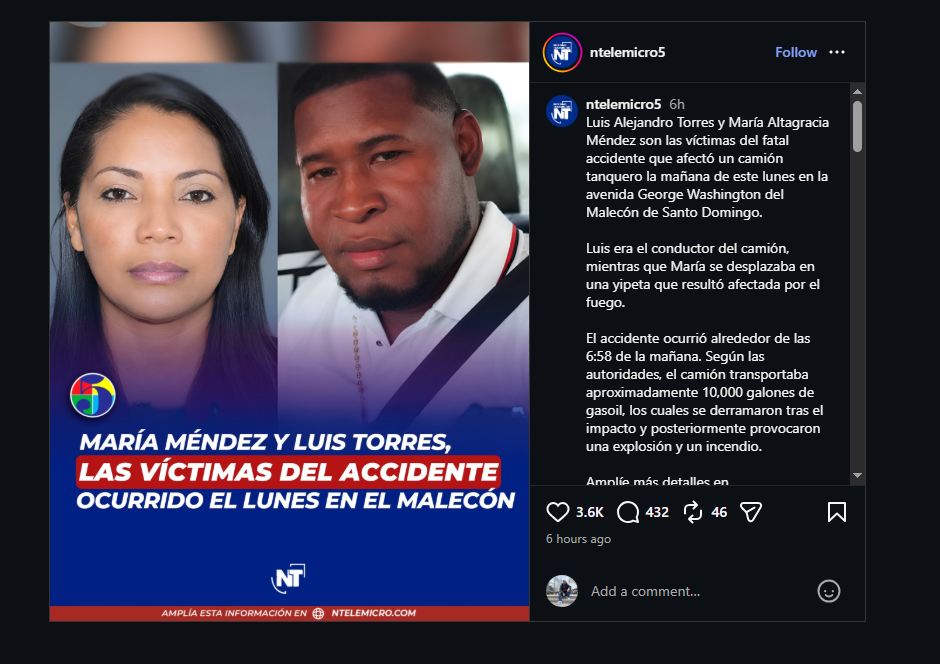
Link to the source: https://www.instagram.com/p/DcLtpSSHCUw/ **Credits to NTeleMicro5.com
Sources and Documentation:
DR1.com forum thread on the Malecon tanker accident (August 18, 2026) Diario Libre detailed reporting on the incident (August 18, 2026) Official government prohibition order (January 30, 2025) Fire department statements from José Luis Frómeta Herasme Digesett spokesperson Rafael Tejeda Baldera Local account from Centro Educativo Imara neighborhood resident