
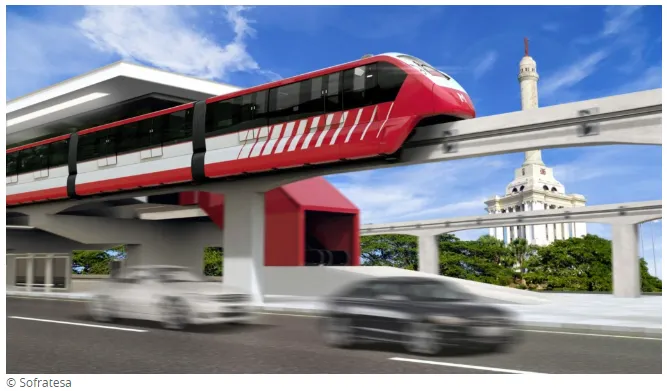
Public accountability in Dominican infrastructure is taking another heavy hit. Serious questions are mounting regarding how the state is handling the funding for Phase I of the Santo Domingo Monorail. Recent technical audits and investigative reports have laid bare a troubling trail of administrative shortcuts, misaligned legal authorizations, and certified funds that simply do not exist in practice.
State fiduciary entity Fiduciaria Reservas certified more than RD$28.46 billion in backing for the project. Yet that entire certification rests on a US$500 million credit operation that was neither disbursed nor legally assigned to a monorail system in the first place. When financial backing for a megaproject of this scale relies on bookkeeping creative writing instead of cash in hand, taxpayers are left footing the bill for an accountability vacuum.
The Anatomy of a Phantom Fund
The administrative paper trail began on September 5, 2025, when Fiduciaria Reservas issued Fund Availability Certification 08/25. This document gave the green light to proceed with detailed engineering, civil infrastructure, and auxiliary systems for the first phase of the Santo Domingo Monorail, pegging the contract baseline at an eye-watering RD$28,462,862,994.24.
To justify that massive sum on paper, the certification leaned on a US$500 million credit line supposedly backed by the 2025 National Budget under Law 80-24. But looking closely at the statutory text reveals a massive disconnect. Article 71, Item 34 of Law 80-24 did not grant cash. It merely authorized the central government to negotiate and attempt to arrange a sovereign credit operation with international commercial banks.
As transport economics experts have pointed out, legislative permission to borrow money is miles away from a closed loan agreement, and an executed loan agreement is still not a cash disbursement. None of these administrative milestones equate to having actual funds available. Compounding the confusion, the certification itself noted that formal contracting would depend on the 2026 National Budget, legislation that had not even been submitted to or debated by Congress when the tender launched.
Misaligned Legal Authorization and Statutory Drift
The financial sleight of hand goes deeper than timing. The legal authorization granted under Law 80-24 was specifically tied to the construction project for the Santo Domingo Metropolitan Train, a completely different engineering initiative managed by the Ministry of the Presidency through the Trust for the Development of Mass Transportation.
The Metropolitan Train and the Monorail utilize entirely different technologies, alignments, and operational blueprints. One is designed around heavy commuter rail specifications while the other relies on elevated beam monorail architecture. Despite these fundamental technical variances, the 2025 procurement call went out for a monorail system. Review of public contracting records shows no executive decree, legislative amendment, or official administrative resolution explaining how funding explicitly earmarked for a commuter rail line was quietly repurposed to back a monorail.
This practice of statutory drift treats public funds as interchangeable buckets rather than legally bound appropriations. When an authorizing law specifies one mode of mass transit, shifting those financial guarantees to an entirely different project without congressional sign-off bypasses the constitutional checks designed to protect the national treasury.
Institutional Silence and the Audit Gap
The lack of transparent reporting surrounding these transactions highlights a deeper systemic failure in how oversight bodies operate. Under internal regulations and the General Manual of Ordinary Public Contracting Procedures, strict alignment between planning, budgeting, and contracting is mandatory before any sovereign financial commitment can be formalized.
Independent technical consultants like Carlos Sully Bonnelly Ginebra have analyzed these discrepancies through columns in El Nuevo Diario, pointing out that state fiduciary management is glossing over the absence of verified capital. Instead of concrete fiscal audits, the public receives assurances backed by future conditional budgeting. Fiduciaria Reservas, operating as the financial vehicle, certified billions based on credit authorizations that remained unexecuted at the time of the tender.
Citizens and oversight bodies deserve straightforward answers to basic questions:
- Where is the binding documentation proving that the US$500 million was actually secured before launching a multi-billion-peso tender?
- What legal act permitted the administration to redirect funds approved for a metropolitan train directly into a monorail project?
- Why did oversight institutions permit certification of funds that relied entirely on future legislative approvals yet to be debated?
The Broader Impact on National Infrastructure
When billions of pesos are committed on paper without real oversight, public trust erodes. Megaprojects require documented facts, not administrative expectations. The Dominican Republic faces critical infrastructure decisions leading up to 2028, and transparency cannot be treated as an optional administrative formality.
Financing models that stretch statutory boundaries create hidden fiscal liabilities. If the state borrows against authorizations meant for alternative projects, it jeopardizes the entire portfolio of planned urban transit solutions. Taxpayers carry the ultimate risk when administrative creativity replaces rigorous financial auditing. The public record demands real clarity, and accountability must start with transparent bookkeeping.