
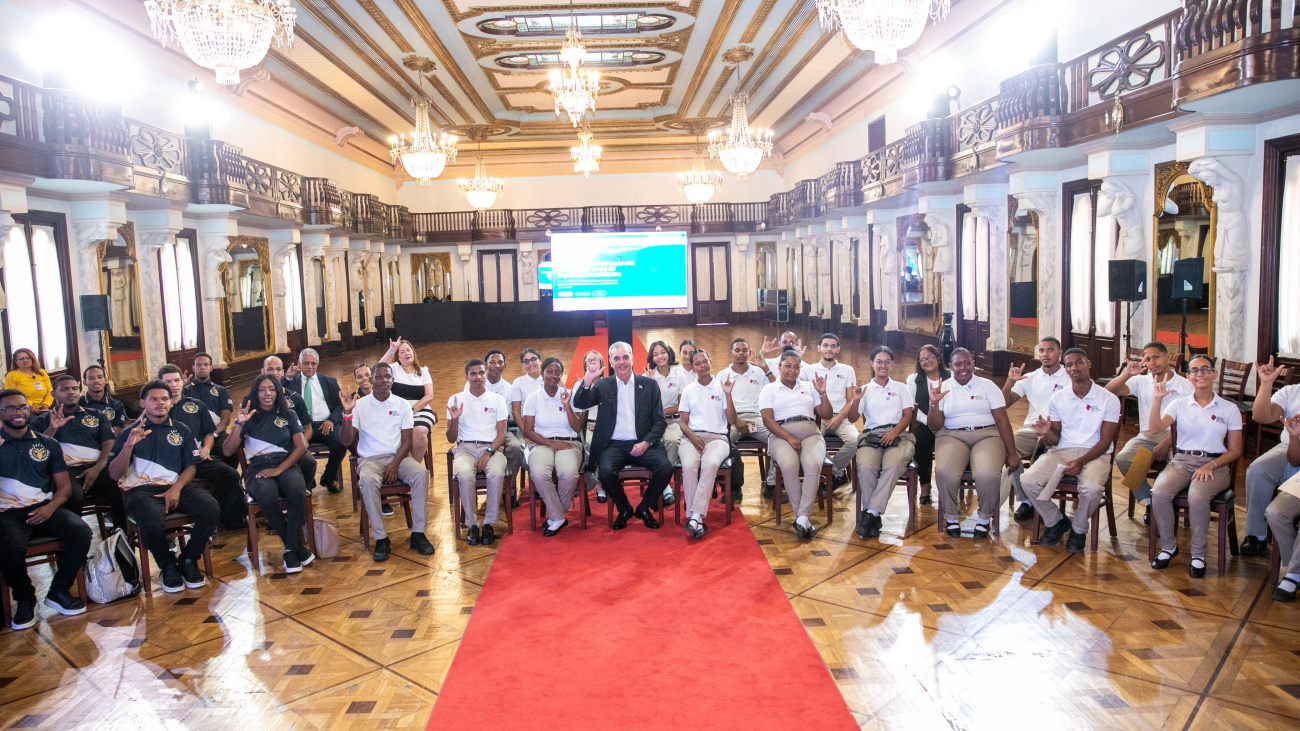
When President Luis Abinader met with 53 deaf students who completed an artificial intelligence training program this week, he signaled something that goes far beyond a single cohort of students. He signaled that the Dominican Republic is ready to build tech infrastructure that actually includes deaf people from the ground up, not as an afterthought.
This matters more than most people realize.
The Numbers Are Real
QVITAE and the General Directorate for Community Development ran a program that achieved an 80 percent completion rate with scores above the national average. Eighty percent. That’s not charity work. That’s proof that when deaf students get real access to technology training, they perform at the same level or better than their hearing peers. One student, David Pérez Soriano, built an actual website for the National School for the Deaf as part of his training. That’s not a certificate on a wall. That’s a deliverable.
But 53 students is a start. It’s not a solution.
The Real Problem: Access Isn’t an Accommodation, It’s Infrastructure
For decades, deaf people in the Dominican Republic have been told that education and career opportunities exist if they just try harder, work through interpreters, adapt to systems built for hearing people. That’s backwards. The systems themselves are the problem.
When you build technology infrastructure with deaf people in mind from the beginning, you don’t create special programs. You create better programs. Full stop. Better user interfaces. Better communication tools. Better accessibility for everyone.
The Dominican Republic has a choice right now. It can treat deaf youth in tech as a diversity initiative, something to celebrate once a year when a program works out. Or it can recognize that deaf talent in tech is a competitive advantage. That deaf engineers build better infrastructure. That deaf-led companies understand accessibility as a core feature, not a bolt-on.
Why This Matters Economically
The Caribbean tech sector is growing. Companies are building infrastructure here. They’re looking for talent. They’re competing for engineers who can scale operations across multiple markets and multiple languages. A deaf engineer who grew up navigating systems that weren’t built for them? That engineer knows how to solve hard problems. That engineer builds resilience into code.
But we lose that talent if we don’t invest in education at scale. Right now, 53 students finished a training program. How many more are there who never got access to that training? How many are working jobs below their skill level because the educational pathway didn’t exist?
The Dominican Republic can invest in scaling deaf AI education now, or it can watch those students leave for opportunities in the United States, Canada, or Europe. That’s not a guess. That’s what happens when one country builds infrastructure and others don’t.
What Scaling Actually Means
It means more than running the same program again next year with more students. It means building sustainable infrastructure that turns training into careers. It means partnerships between government, private sector, and community organizations that create real pathways from education to employment.
It means investing in infrastructure that deaf students can use independently, not programs they have to navigate with an interpreter standing next to them. It means building platforms and tools developed by deaf people for deaf people, not solutions designed by hearing people and retrofitted with accessibility features.
It means the Dominican Republic becoming a regional leader in accessible tech talent development. Because nobody else is doing this yet. The Caribbean doesn’t have a unified approach to deaf inclusion in tech education. The DR could set that standard. It could become the place where deaf youth come to learn, where deaf-led tech companies base their operations, where regional governments look to understand how inclusion actually works at scale.
The Window Is Open
President Abinader just made a public commitment to deaf community support through education and technology. That’s not accidental. That’s a signal. Government agencies are paying attention. The private sector is paying attention. International organizations are paying attention.
This is the moment to push harder. Not to celebrate what’s been done, but to demand what comes next. More funding. More programs. More infrastructure. More pathways from training to actual employment. More deaf people in leadership roles deciding how these systems get built.
The Dominican Republic has started something important. The question is whether it’s going to treat this as a one-time program or as the foundation for something transformative.
The answer should be clear. Invest in deaf education. Invest in accessible infrastructure. Invest in the talent that’s already here waiting for the opportunity to prove what it can do.
That’s how you build a tech sector that actually works for everyone.
Here is the post directly from the President of Domincian Republic on Instagram so you can see them.