
A Tragedy That Demands Real Change
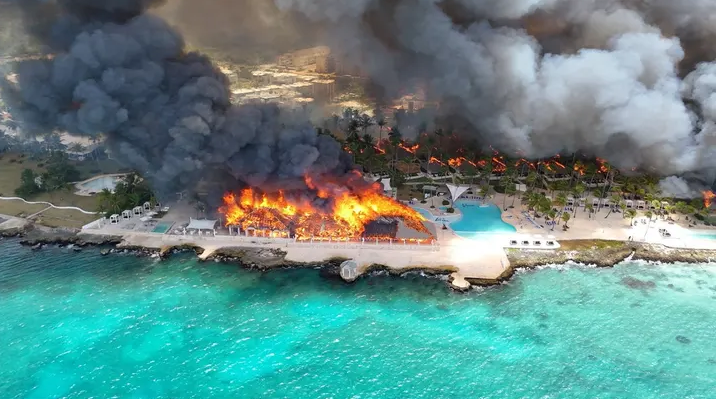
On the morning of June 19, 2026, fire tore through the Viva Wyndham Dominicus Beach resort in Bayahibe. By the time the smoke cleared, one person was dead, nearly 1,690 guests had been displaced from their rooms, and over 170 employees suddenly found themselves without work, without income, and facing the immediate reality of feeding their families and paying rent with nothing in their hands.
This was not an accident waiting to happen. This was a failure we could have prevented.
This post exists because the Viva Dominicus fire reveals something the Dominican Republic’s tourism industry does not want to discuss: we have built a multi-billion dollar sector on the foundations of inadequate safety infrastructure, weak regulatory oversight, and a system that treats guest comfort as more urgent than guest survival. The fire also exposed a deeper truth about who suffers when these systems fail. It is not the hotel owners. It is the workers, the families depending on tourism jobs, the people who have no cushion when catastrophe strikes.
The photos and screenshots used throughout this post come from respected news media outlets and publicly available sources documenting this event. They are presented here for educational purposes to illustrate the severity of this fire, the scale of the emergency response challenges, and the real conditions workers and guests faced during evacuation. This content is used to support analysis of Dominican Republic’s safety infrastructure and to advocate for stronger building codes, mandatory fire suppression systems, and emergency preparedness standards.
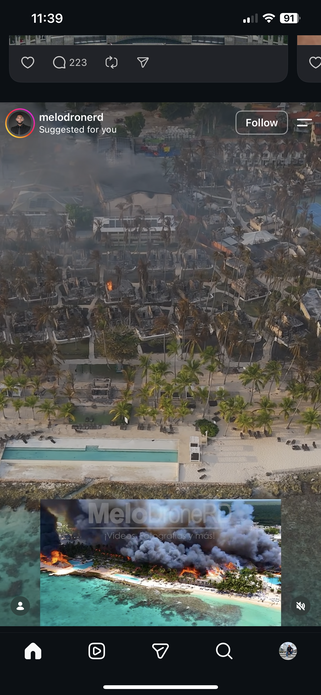
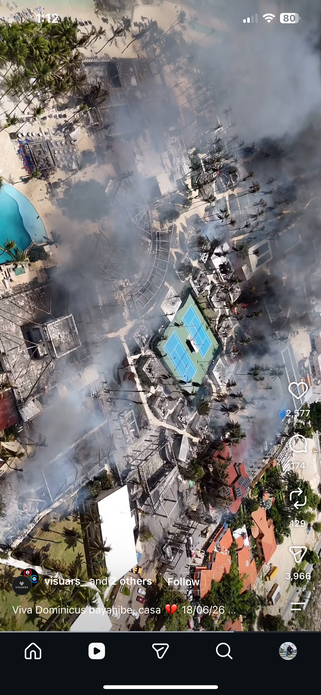
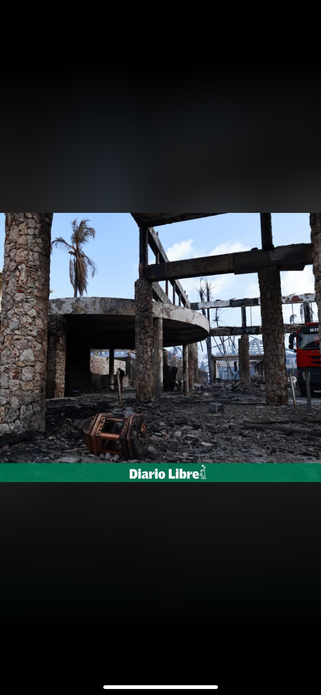
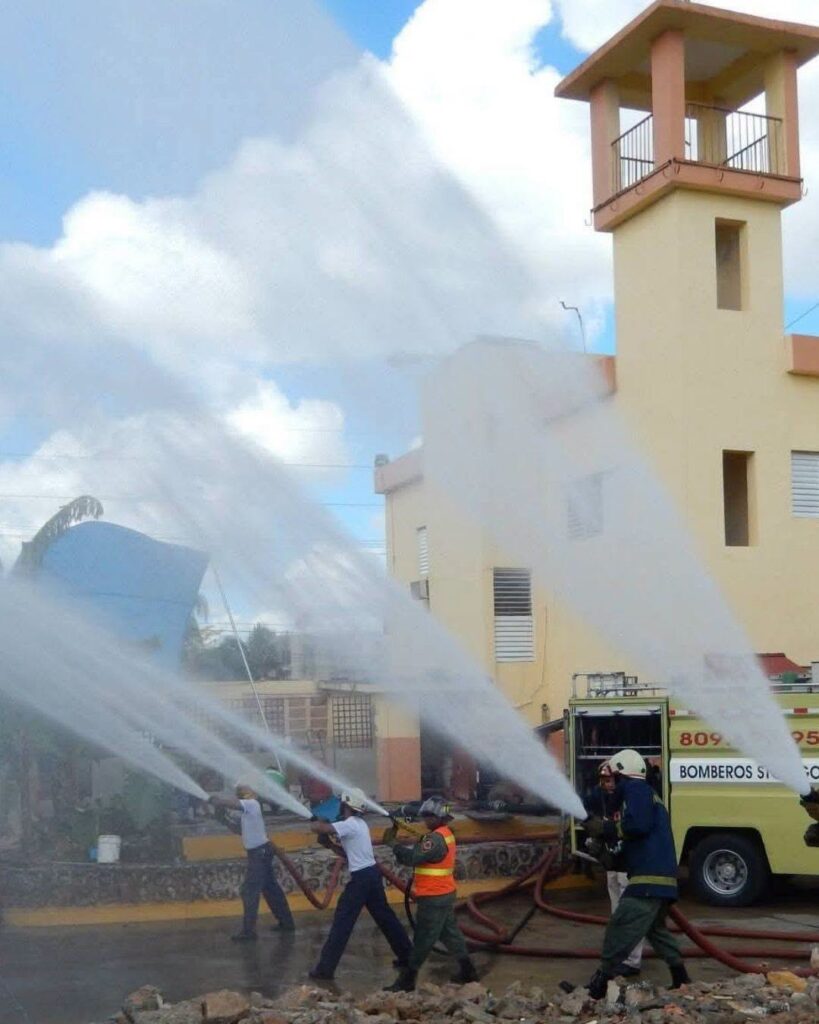
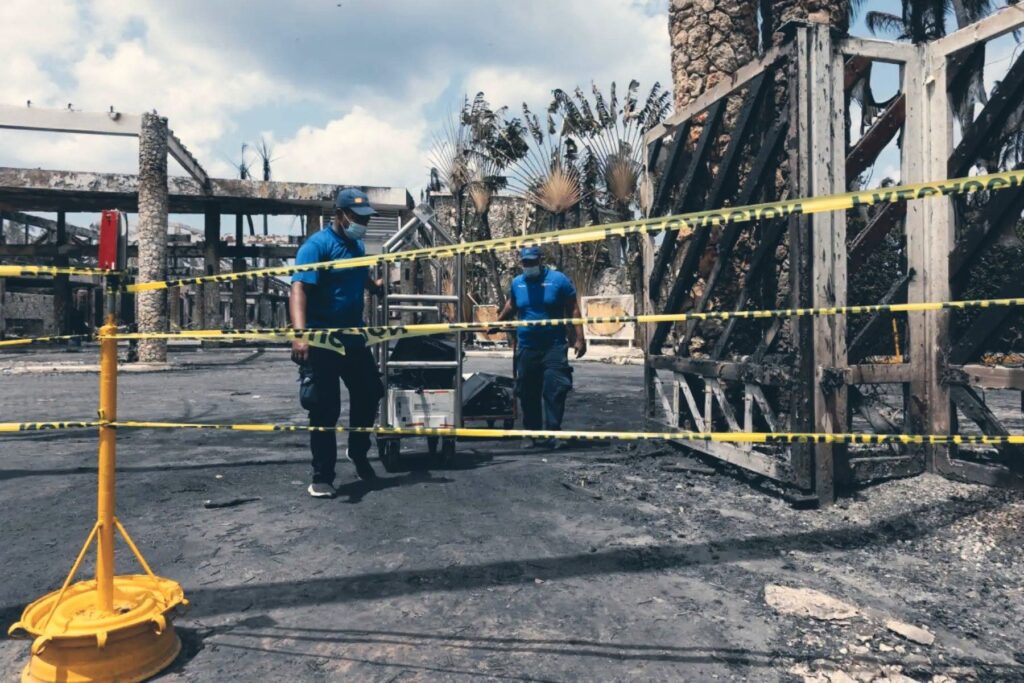
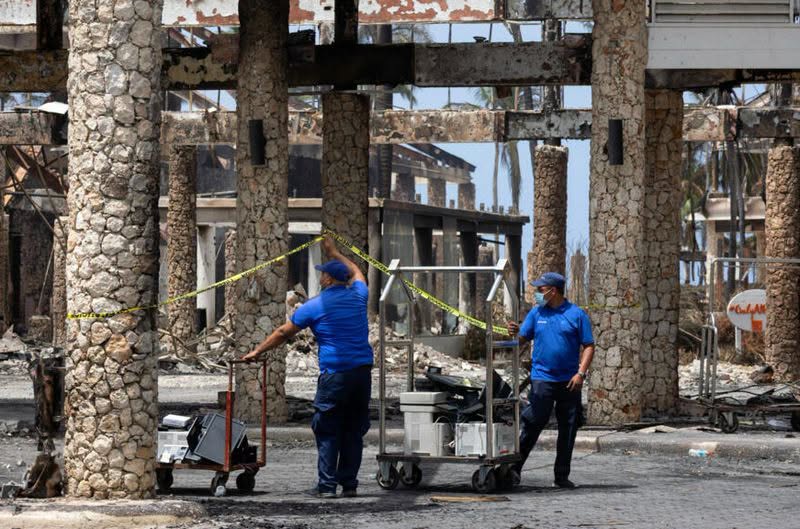
This is the aftermath after the fire was put out at the Viva Dominicus Hotel:
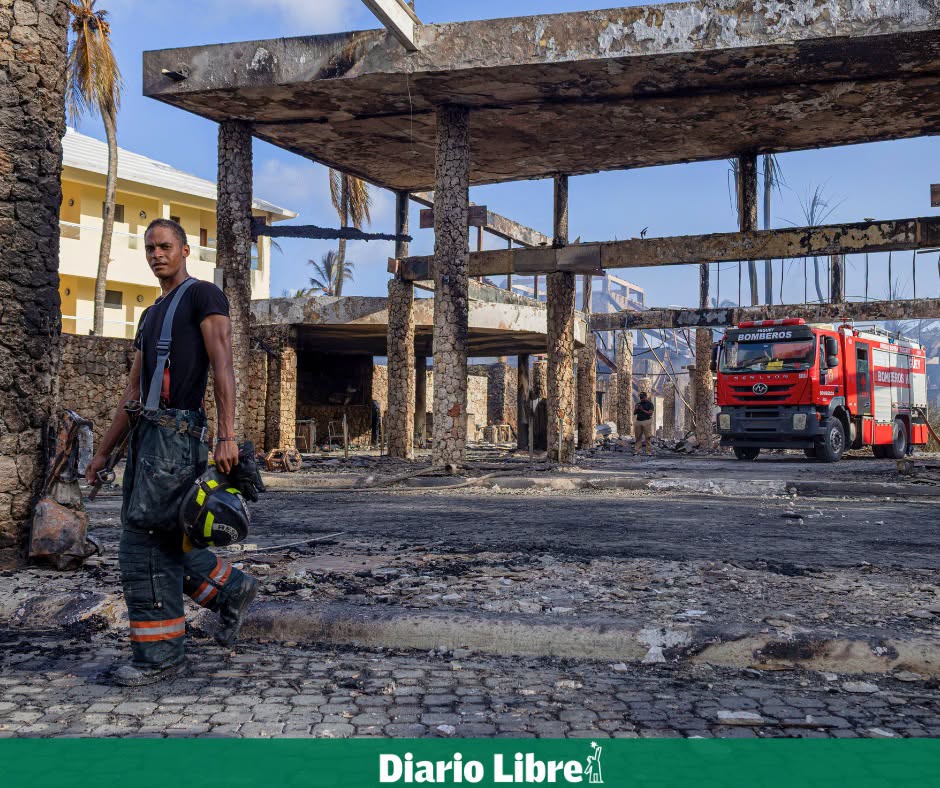
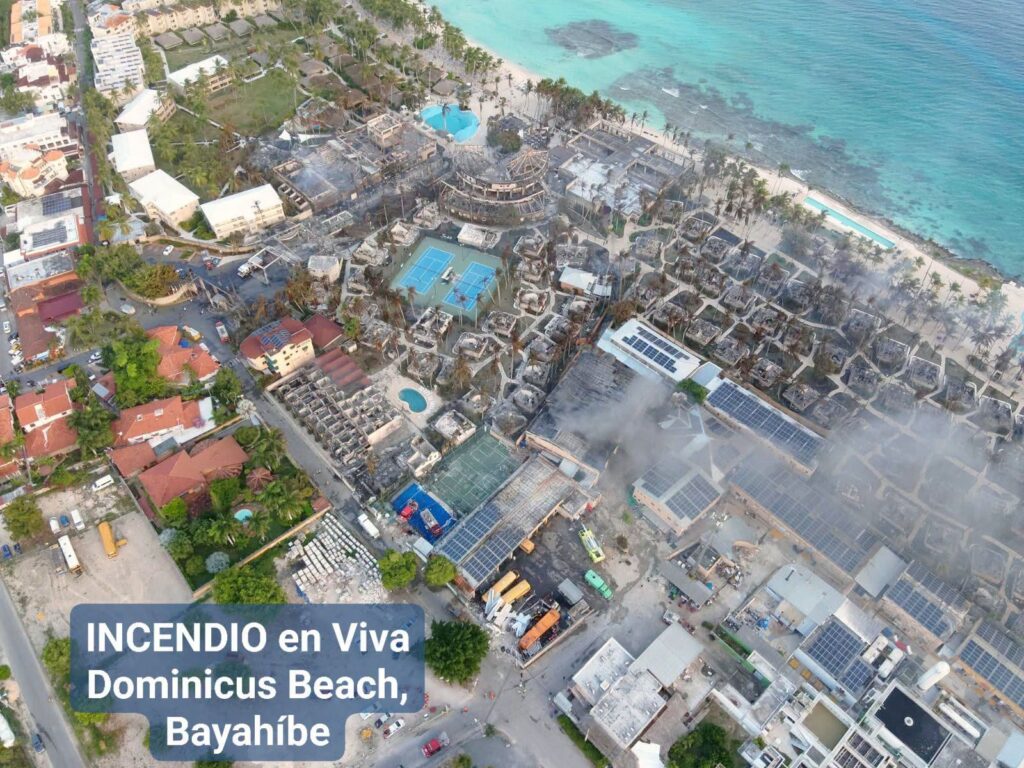
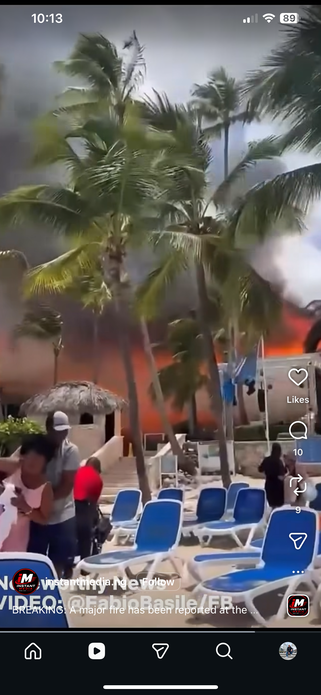
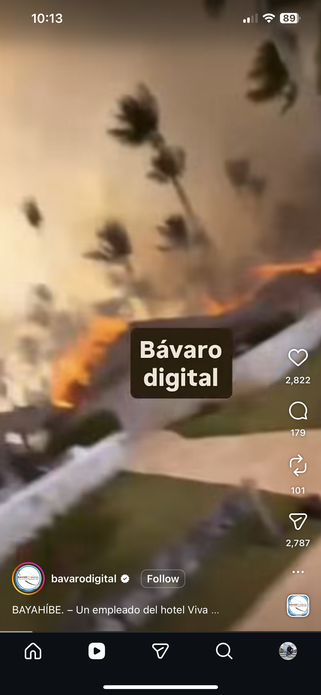
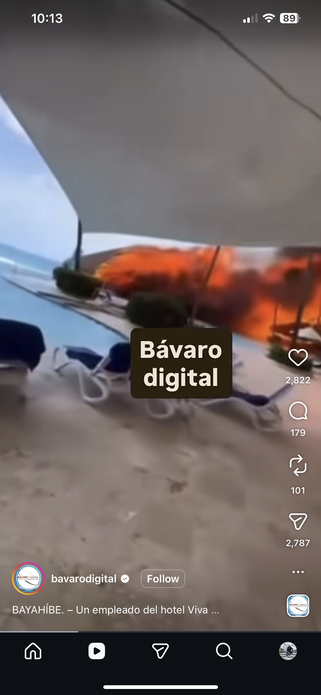
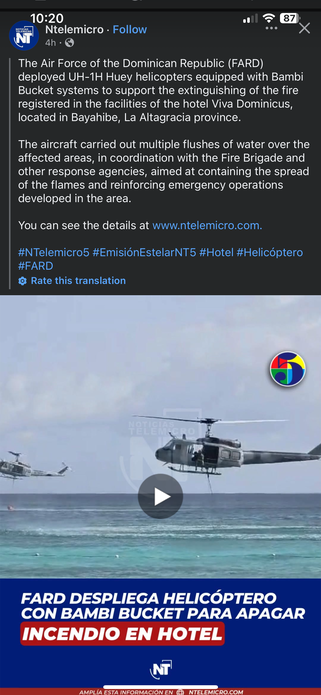
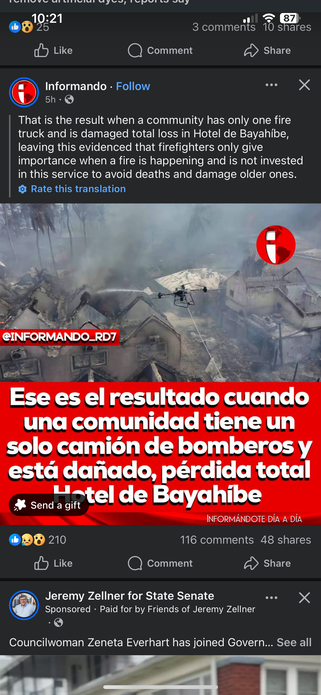
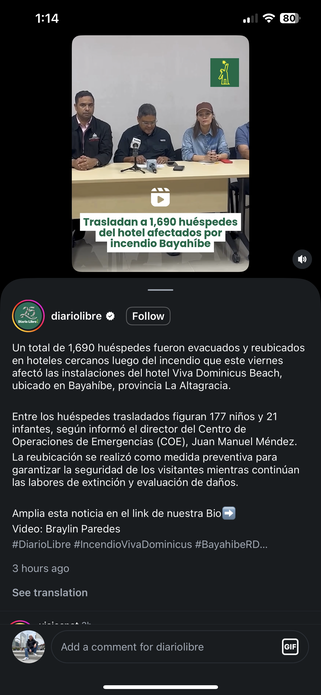
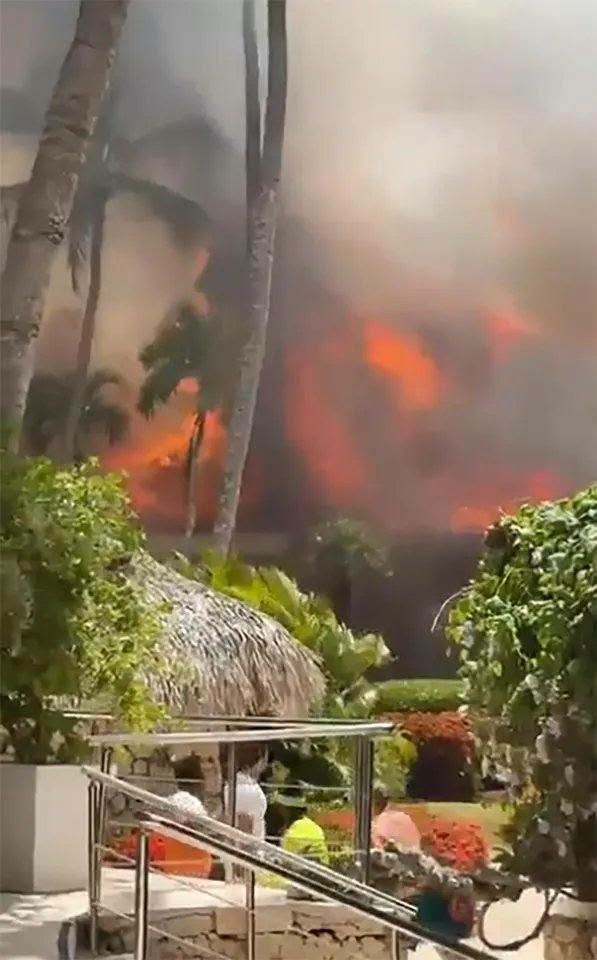
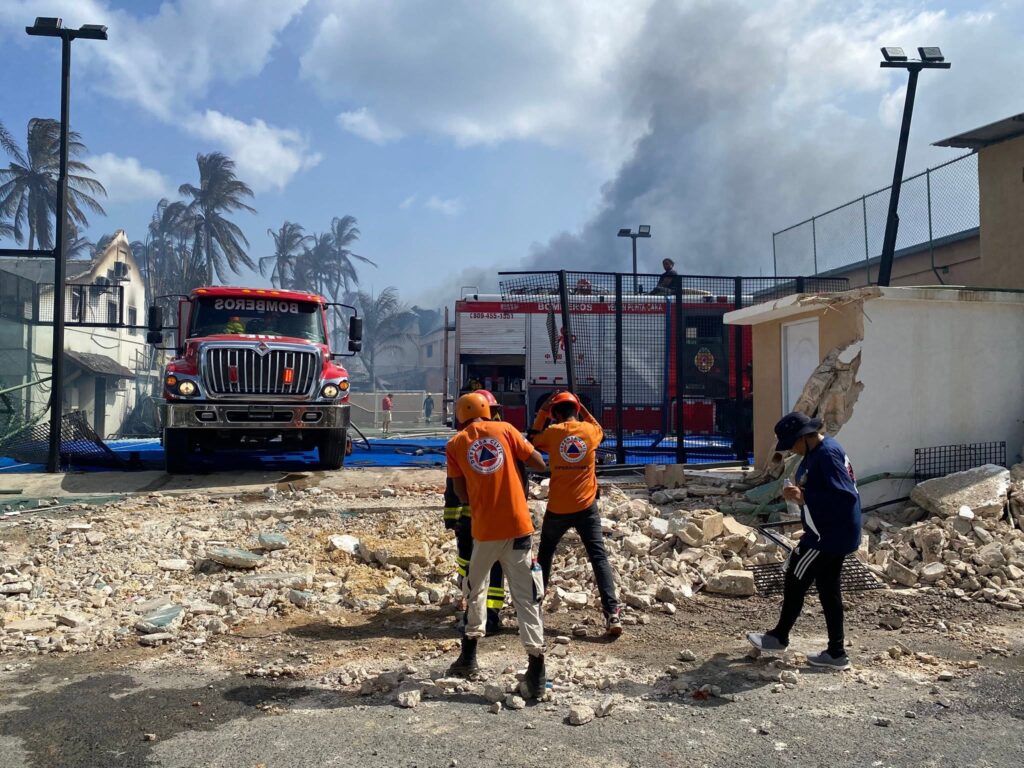
Photo Gallery of the event that happened at the Vivia Dominicus hotel:
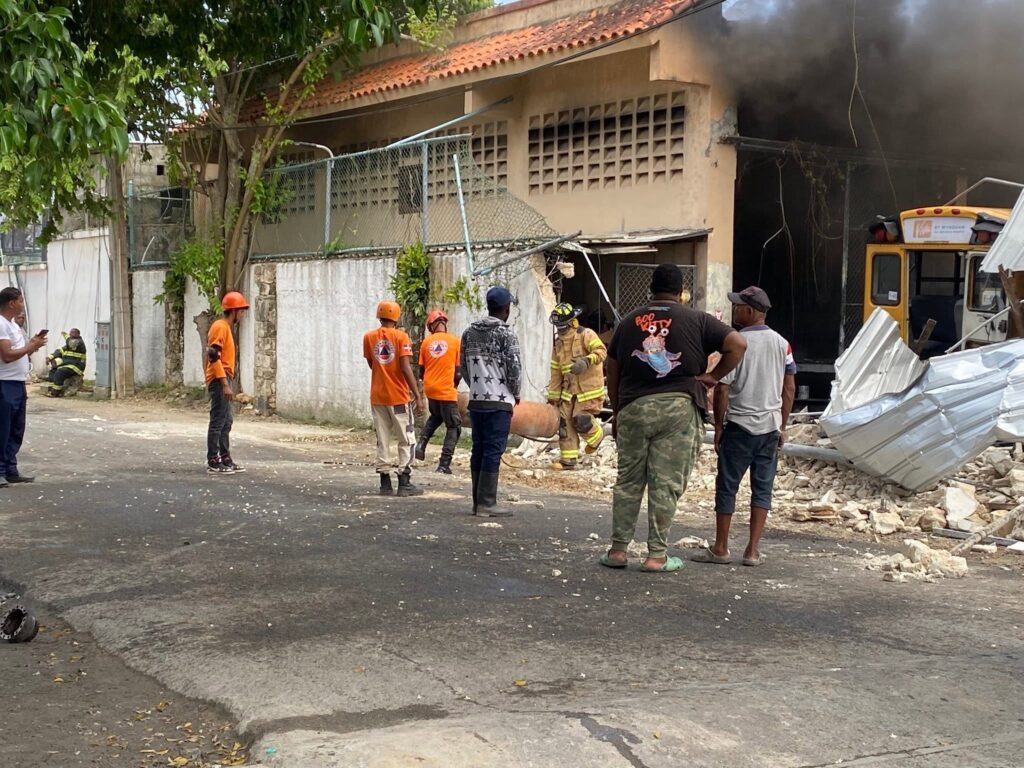
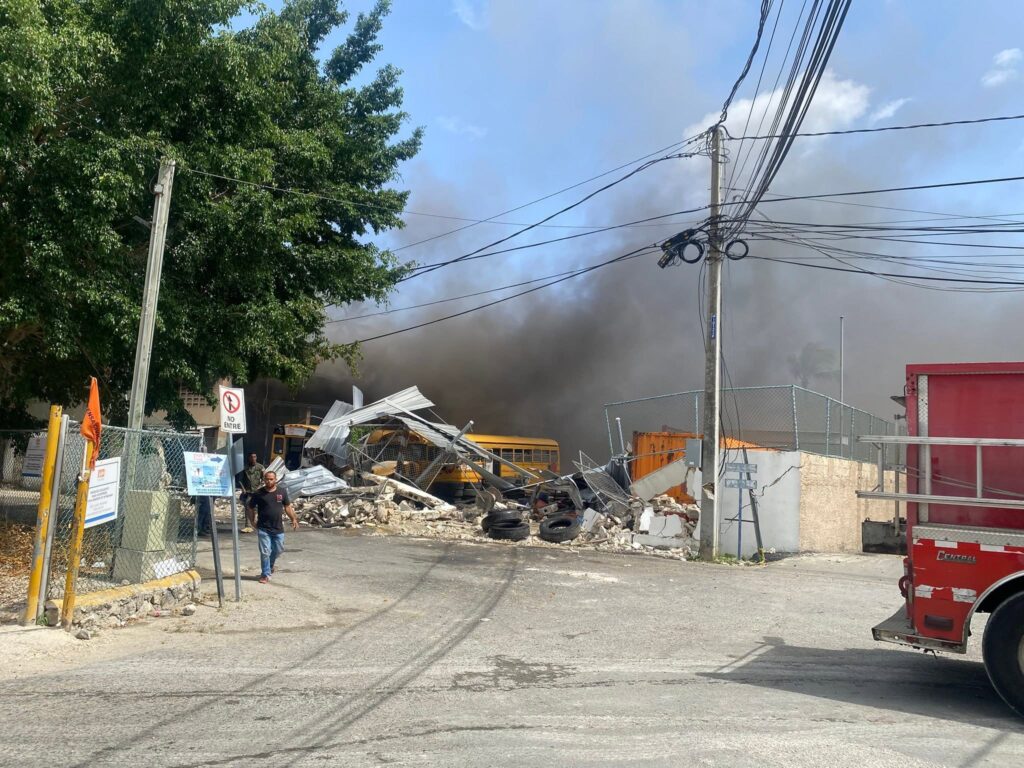
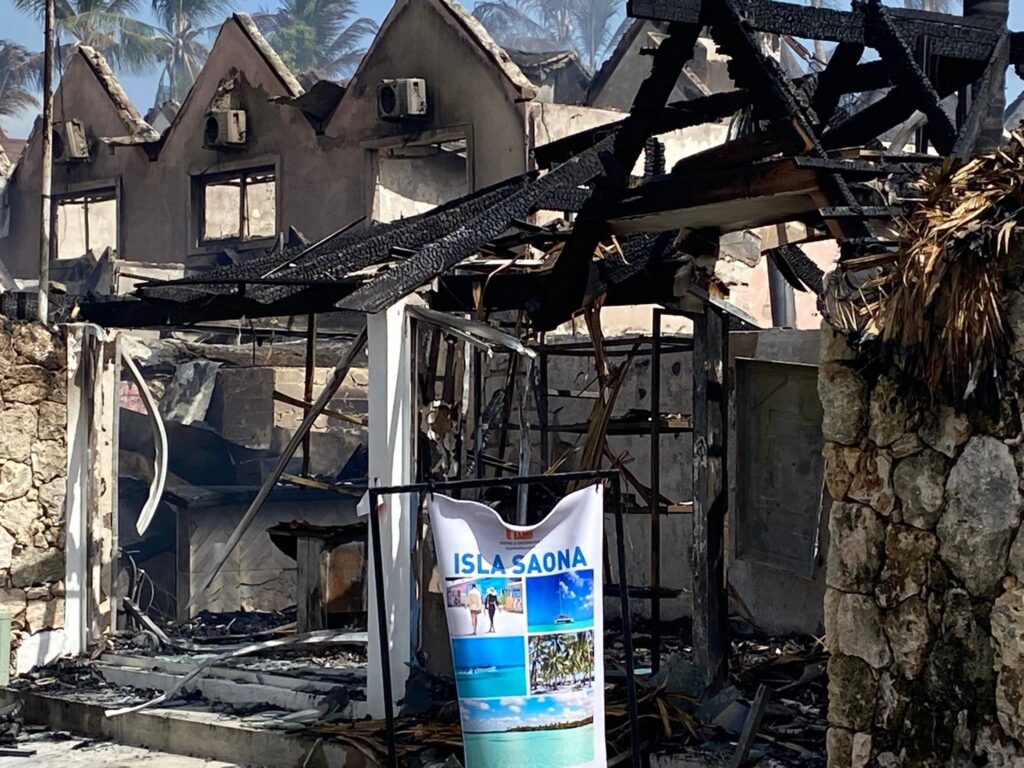
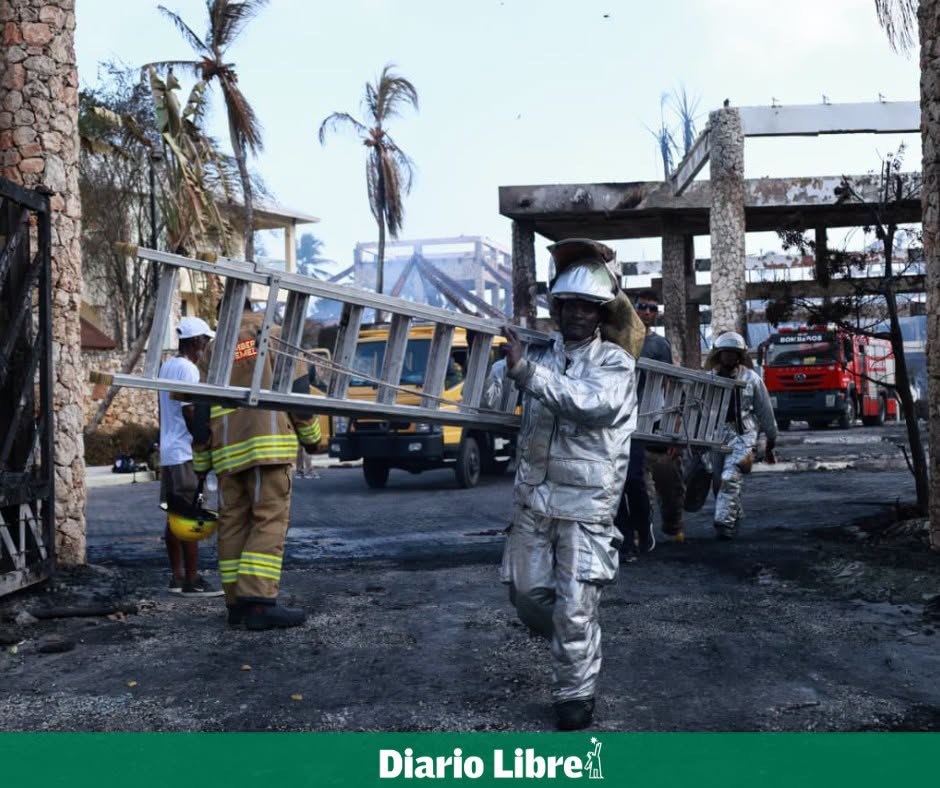
The Fire: What Happened and Why It Spread So Quickly
At approximately 11 a.m. on Friday, June 19, 2026, fire broke out in the beachfront structures of the Viva Dominicus Beach hotel. What started as a localized fire became a massive emergency in minutes.
Cellphone videos captured the chaos. Thick black smoke billowed into the sky. Flames consumed entire sections of the resort, particularly the thatch-roofed structures that make up much of the beachside bungalow complex. Tourists waded into the ocean. Some jumped into the water to escape the smoke and heat. Emergency sirens wailed across Bayahibe. Police vehicles blocked roads. Helicopters appeared overhead.
The fire took approximately five hours to contain. By the time firefighting units brought it under control, large portions of the resort had been destroyed.
The emergency response involved 22 fire trucks, 8 water supply trucks, 2 Dominican Air Force helicopters equipped with aerial water-dropping systems (Bambi Bucket technology), and 10 ambulances. This was a maximum effort response. The military had to be activated. Aviation assets had to be deployed. Yet even with this level of response, the fire spread faster than ground-based equipment could contain it, requiring aerial water drops to prevent complete devastation of adjacent properties.
The Center for Emergency Operations (COE) confirmed the full scale of the response: 475 personnel deployed to fight the fire, coordinated use of tank trucks and Air Force helicopters. This was not a routine fire response. This was a major emergency mobilization of the Dominican Republic’s emergency infrastructure.
Why the Fire Spread So Fast
The Dominican Republic’s Emergency Operations Center identified the root cause: the resort’s roof was constructed using cane and thatch materials, both highly combustible substances. Combined with strong wind conditions that day, the fire had everything it needed to spread rapidly across connected structures.
This is not a mystery. This is not an act of God. This was a choice.
Thatched roofing looks good in marketing materials. It creates an aesthetic that appeals to tourists seeking that “authentic Caribbean experience.” It also costs less than alternatives. In the competition to maximize profit margins, the Viva Dominicus resort chose materials that, when ignited, would spread fire like gasoline on a wooden floor.
Strong winds are not unexpected in June in the Caribbean. Heat is not unexpected. The conditions that made this fire catastrophic were entirely predictable. Yet the resort operated with roofing materials that turn a manageable fire into an inferno the moment a spark meets them.
This is what happens when hotel planning prioritizes revenue over risk mitigation. When marketing beats safety. When cutting costs in construction becomes acceptable because the legal and regulatory environment allows it.
The Role of Emergency Equipment
Firefighters from La Romana responded immediately. Fifteen firefighting units converged on the resort. Emergency responders worked for hours to contain the blaze.
But firefighters can only do what their equipment allows them to do. And here is where the second failure begins: the Dominican Republic does not have adequate fire infrastructure to handle large-scale emergencies.
The available fire trucks, hoses, and equipment struggled to contain the fire. Videos from the aftermath show drones spraying water on smoldering ruins. Why drones? Because the scale of the fire exceeded the capacity of available ground-based firefighting equipment. Emergency teams were forced to use alternative methods because the standard infrastructure was not sufficient.
In the United States, commercial properties of this size would have fire hydrants at regular intervals, sprinkler systems inside the buildings, access roads wide enough for fire trucks, and emergency water supplies available within the facility itself. Fire codes require all of this. Buildings are inspected and reinspected. Violations result in fines, citations, closure orders if not corrected.
The Dominican Republic has none of this infrastructure. Not at this resort. Not across the country.
A System Designed for Dollars, Not Safety
The Dominican Republic is the Caribbean’s most visited destination. The tourism industry brings in billions of dollars annually. It is the economic engine that powers the country. And because it is the economic engine, the government bends to protect it.
This is not hyperbole. This is the structural reality of how tourism operates in small island economies.
When a fire happens, the government rushes to assure tourists that everything is fine, that tourism operations continue, that other resorts are unaffected and operating normally. The Emergency Operations Center released statements emphasizing that “tourist activities in Bayahibe and the surrounding area remain unaffected and continue to take place safely and as normal.” This messaging was released within hours of people dying.
The priority is reassuring international tourists and investors that they can still come to the Dominican Republic, that it is still safe to book vacations here, that this incident was isolated and not systemic.
The actual safety of the facilities? That is a secondary concern.
When hotels are built, they are built to maximize profit. Land acquisition, architectural design, construction materials, staffing levels, training protocols, emergency procedures, and building maintenance are all budgeted to hit a price point that works financially for the ownership. Safety measures cost money. They reduce profit margins. So they get minimized.
The regulatory environment that should prevent this does not function effectively. Building inspections exist but are not rigorous. Code enforcement exists but has limited teeth. Fines for violations are often smaller than the cost of compliance, which means rational actors in business simply pay the fine and keep operating as usual.
This is the system that allows a major resort to operate with highly flammable roofing materials in a hurricane-prone region with inadequate fire suppression equipment. This is the system that prioritizes marketing aesthetics over structural safety.
And when catastrophe strikes, the system protects the industry first and the people second.
The Immediate Crisis: 1,690 Guests, 170+ Employees
Let’s talk about what the official numbers actually mean.
1,690 guests were evacuated from the Viva Dominicus resort. These people lost everything immediately accessible to them. Rooms, belongings, identification documents, passports, credit cards, luggage. Some people had just arrived. Some were weeks into their vacation. All of them had to be moved to other hotels and temporary housing within hours.
The Emergency Operations Center and hotel management coordinated the relocation. Buses came. Guests were transported to nearby properties. The Viva Wyndham Dominicus Palace, a sister property that was not damaged, absorbed some guests. Other nearby hotels opened rooms. Tourism authorities worked around the clock to get people accommodated.
From the guest perspective, this was handled relatively efficiently given the scale. Most tourists were in new hotel rooms by evening. The experience was disruptive, frightening, and inconvenient, but manageable for people with resources.
But then there are the 170+ employees.
The hotel closed immediately. Not temporarily. Closed. The resort, which was severely damaged and is now under investigation, is not operating. Which means the jobs that existed there are gone. Not suspended. Not waiting to be restored. Gone, at least for the foreseeable future. T
he Immediate Aftermath: Government Response and Logistics The Center for Emergency Operations (COE) confirmed the complete extent of the emergency response. The fire was completely extinguished following a deployment of 475 personnel, coordinated tank truck operations, and Dominican Air Force helicopter support. This was not just 15 firefighting units. This was a massive mobilization of the Dominican Republic’s emergency response capacity.
The 1,690 evacuated tourists received essential items immediately and were relocated to Miches and Bayahibe. The Ministry of Tourism and the Directorate of Migration took coordinated control of the case, handling logistics, documentation, and international coordination.
For the tourists, this coordination was critical and relatively effective. Within hours, people who had been evacuating by jumping into the ocean were in new hotel rooms with fresh clothes and access to basic services. This was professional emergency management in action.
But emergency management of guest logistics is not the same as long-term systemic reform. Getting tourists relocated is the minimum responsibility of government and the tourism industry. What the response did not address, and what DR2028 exists to advocate for, is why the resort was operating with the conditions that necessitated this massive emergency response in the first place.
What 170+ People Face When a Resort Closes
A kitchen worker at a resort makes roughly 300 to 400 U.S. dollars per month. A housekeeping staff member makes similar wages. A front-desk clerk might make slightly more. An activity coordinator might make 350 dollars a month. These are the jobs that people in Bayahibe, La Romana, and surrounding communities work because the tourism industry is the primary employer.
Now imagine you showed up for work on June 19 and were told the resort caught fire and you no longer have a job. You have no severance. You have no unemployment insurance. There is no worker displacement fund. The government does not have emergency assistance programs to keep you housed while you look for new work.
You have a family. You have rent due on July 1st. You have food to buy. You have school costs for children. You have medical expenses. You have utilities to pay. You have a motorcycle to maintain. All of this continues, costs-wise, while your income drops to zero.
What do you do?
In the United States, a worker in this situation would file for unemployment, which would provide partial wage replacement while looking for new work. There would be emergency assistance programs. There might be disaster relief. The labor department would investigate whether the employer had insurance to cover workers. There would be legal protections for workers and potential liability claims.
In the Dominican Republic, a worker in this situation faces a much harsher reality.
Hotel unions exist but are not powerfully organized across the entire sector. Labor protections exist but are weaker and more poorly enforced than U.S. standards. There is no unemployment insurance system like the American model. There is no automatic severance requirement. There is no emergency relief. The worker must go to the hotel management and hope they offer some kind of compensation package. If they do not, the worker has limited recourse.
Some workers might have saved money. Some might have family to lean on. Many do not. Many live paycheck to paycheck because 300 to 400 dollars a month is barely sufficient to cover basic needs in the Dominican Republic, let alone allow for savings.
So those 170+ people faced an immediate crisis. Within days, some would have had rent notices. Within a week, some would have missed meals. Within two weeks, some would have been seeking emergency assistance from family, church, or community organizations. Within a month, some would have been in debt or facing eviction.
This is not speculation. This is the reality of living in a country where worker protections are minimal and the tourism industry operates as the primary employer.
And the government’s response to these workers? Silence. The Emergency Operations Center issued statements about how tourism operations would continue. There were no announcements about emergency assistance for displaced workers. There were no government programs activated to help them transition to new employment. There was no commitment to investigate whether labor laws had been violated.
The workers were not the priority. The industry was.
The Broader Employment Reality
This is worth understanding at scale. The Viva Dominicus was one resort. But the tourism industry in the Dominican Republic employs hundreds of thousands of people directly and hundreds of thousands more indirectly. These are people working as kitchen staff, housekeeping, security, activity coordinators, guides, drivers, vendors, and in a hundred other roles.
The vast majority of these workers are not wealthy. They do not have investment portfolios or property portfolios. They do not have corporate benefits or 401k plans. They work because they need to eat. They work because their children need to go to school. They work because their family depends on them.
When a resort closes, when an industry segment contracts, when a hurricane hits, when a pandemic stops travel, those workers face immediate economic catastrophe. They have no shock absorbers. They have no backup plan.
The fire at Viva Dominicus is a concentrated example of a systemic problem: a tourism-dependent economy creates massive vulnerability for the working people who fuel that economy. One disaster, one closure, one economic disruption, and they fall into crisis.
This is what drives poverty in the Dominican Republic. Not laziness. Not lack of opportunity. But structural vulnerability combined with weak social safety nets.
Why the Military Had to Bring Water
One of the most telling details from the Viva Dominicus fire is this: drones had to spray water on the fire. Military or emergency response drones because the available firefighting equipment could not deliver adequate water to the scene quickly enough.
Why would this be?
Let’s think about fire suppression infrastructure in a U.S. city. A commercial complex of significant size would have:
Multiple fire hydrants positioned around the property, spaced no more than 500 feet apart, connected to a reliable municipal water system. Each hydrant provides access to pressurized water that allows fire trucks to connect and pump thousands of gallons per minute. Fire trucks carry additional water in their tanks, but they rely on hydrants to replenish supply during long operations.
Internal sprinkler systems installed in the buildings, designed to suppress fire before it spreads. These systems are monitored, tested, maintained, and inspected annually.
An emergency water supply, sometimes in the form of water tanks or pools dedicated to emergency use, ensuring water availability even if the municipal supply fails.
Access roads wide enough for fire trucks and emergency vehicles to reach all parts of the complex.
Building design that includes emergency exits, evacuation routes, and structural features that slow fire spread.
All of this is required by building code. All of it is inspected. Violations result in citations and closure orders.
The Dominican Republic does not have this infrastructure at commercial properties. Not consistently. Not at the level that would meet U.S. fire code standards.
The Viva Dominicus resort, despite being a major luxury property, apparently did not have adequate on-site fire suppression infrastructure. This is not an unusual situation in the Dominican Republic. It is the norm.
So when the fire broke out, firefighters arrived and deployed available equipment, but they were hampered by the lack of accessible hydrants and pre-positioned water supplies. The emergency response had to be improvised. Drones delivering water. Military vehicles potentially involved in supplying water. Alternative methods because the standard infrastructure did not exist.
This is what happens when you build a tourism industry without the safety infrastructure that the industry requires.
The Cost of Not Building Hydrants
Building a fire hydrant system costs money. Real money. A municipality installing fire hydrants across a tourist zone would need to:
Install water mains deep enough to prevent freezing, wide enough to deliver high volume. In the Dominican Republic, this also means burying lines deep enough to withstand hurricane-force winds and salt-water conditions.
Install valve systems to control flow and isolate sections for maintenance.
Install hydrants themselves at regular intervals.
Install monitoring systems to detect leaks and failures.
Conduct regular maintenance and testing.
Train fire department personnel on system operation.
The initial capital cost is substantial. The ongoing operational cost is significant. For a developing country with limited government revenue, this is a real budget burden.
So the choice is made: prioritize immediate services like roads, electricity, potable water to homes, education, healthcare. Defer the specialized infrastructure that serves emergency response.
This makes fiscal sense at the government level. But it creates a deadly gap between what tourism properties have and what they need to safely operate at scale.
Other Caribbean nations have made different choices. Some have invested in emergency response infrastructure because they recognized that tourism safety is tourism viability. The Dominican Republic has not.
And when fire strikes, that gap becomes apparent.
The Regulatory Failure: Why This Resort Was Allowed to Operate
The Viva Dominicus fire reveals a regulatory failure that extends beyond just this property.
The resort was operating with roofing materials that, as the Emergency Operations Center confirmed, are highly combustible. This was not a secret. Thatched roofing is visibly distinctive. Any building inspector, any municipal official, any tourism authority would immediately recognize that this property was roofed with materials that present elevated fire risk.
Yet the property was permitted to operate. It was permitted to operate with 700 rooms and 1,690+ guests daily. It was permitted to operate with what appears to be limited on-site fire suppression infrastructure.
And when fire broke out, the Dominican Republic deployed a massive emergency response. 22 fire trucks. 8 water supply trucks. 2 military helicopters with aerial water-dropping systems. 10 ambulances. This was maximum effort. This was the full capacity of the emergency response system.
And even with that response, the fire spread so quickly that it required aerial water drops to contain. Even with that response, Francesca Valentino died from carbon monoxide inhalation during evacuation. Even with that response, 1,690 people had to be evacuated and relocated.
What this demonstrates is that the building itself was the problem. The emergency response system performed admirably given what it had to work with. But what it had to work with was inadequate infrastructure and a building designed for cost minimization rather than safety.
A properly equipped hotel with sprinkler systems, fire-resistant roofing, and adequate internal fire suppression would have contained the fire automatically. The emergency response would have found a controlled situation, not a raging inferno that required maximum mobilization.
This suggests one of three things:
One: The building did not receive adequate inspection before opening or during operation. Inspectors either never conducted thorough reviews or were not trained to identify fire code violations.
Two: The building was inspected but violations were identified and ignored because the regulatory authority either lacked enforcement power or chose not to enforce standards.
Three: The building code in the Dominican Republic simply does not require the fire suppression standards that would be required in developed countries, so the property was in compliance with local law even though it was operating below international safety standards.
The honest answer is probably some combination of all three.
The Dominican Republic does have building codes. Regulations exist. But they are not uniformly enforced. They are not consistently applied. They do not reach the level of stringency that would be required in developed countries. And the political will to strengthen and enforce them is weak because strengthening codes would increase construction costs and potentially slow tourism development.
So the system reaches a sort of compromise: buildings meet minimum local standards, but not international best practices. Hotels are inspected sometimes but not always rigorously. Violations are sometimes enforced and sometimes overlooked. The result is that properties operating at significantly lower safety standards than comparable U.S. hotels are perfectly legal in the Dominican Republic.
Until something goes catastrophically wrong.
And when it does, the emergency response system has to handle situations that should never have been created in the first place.
What Stronger Building Codes Would Require
A strengthened building code focused on fire safety would mandate:
Sprinkler systems in all buildings over a certain square footage or occupancy level. These are not optional. They are not a luxury. They are required. Full stop.
Fire-resistant roofing materials. Thatched roof would be prohibited for commercial occupancy above a certain threshold. This alone would have prevented a major fire at Viva Dominicus.
Fire walls and barriers to prevent fire spread between compartments.
Emergency lighting and marked evacuation routes.
Fire suppression equipment that is regularly inspected and maintained.
On-site water supply adequate to support firefighting operations.
Parking and access roads of adequate width for fire truck maneuvering.
Emergency lighting powered by backup generators.
Regular safety inspections with documented compliance.
Training requirements for staff on evacuation procedures.
Most of these measures are standard in the United States. They are not luxuries. They are not optional upgrades. They are baseline expectations for any commercial property housing guests.
The Dominican Republic does not have these as uniform requirements. Some properties implement them. Others do not. The choice is often left to the property owner, with enforcement varying based on political relationships and regulatory capacity.
This is the regulatory failure in concrete terms.
The Building Infrastructure Gap Between the DR and Developed Countries
To fully understand what went wrong at Viva Dominicus, it helps to compare the infrastructure and building code environment across countries.
United States Standards
In the United States, a hotel of 700 rooms would be subject to:
International Building Code (IBC) and National Fire Code (NFC) requirements enforced at state and local levels. These codes are comprehensive, regularly updated based on research and incident analysis, and rigorously enforced.
Mandatory fire sprinkler systems in all guest rooms and common areas. These are not an option. They are required. Designed, installed, inspected, and maintained to specific standards.
Mandatory fire-resistant or non-combustible roofing. Thatched roof would not be permitted for commercial occupancy.
Requirements for emergency exits, exit signage, evacuation lighting, and emergency communication systems.
Regular inspections by fire marshals and building code officials. Violations must be corrected within specified timeframes or the property faces fines, citations, and potentially closure.
Insurance requirements that incentivize safety. Insurers will not insure properties that do not meet safety standards. This creates another layer of enforcement.
Liability exposure if a fire results in injury or death and building code violations are identified. Owners, architects, contractors, and property managers can all face legal action.
The combination of regulatory enforcement, insurance requirements, and liability exposure creates a system where fire safety is not optional. It is mandatory, monitored, and expensive to avoid.
Caribbean Standard
In the Dominican Republic and similar Caribbean nations:
Building codes exist but are less comprehensive than U.S. codes. They cover some fire safety but not all elements.
Fire safety standards are lower and less uniformly applied. A property in one municipality might face stricter enforcement than an identical property in the next municipality.
Sprinkler systems are not universally required. They are often seen as optional upgrades rather than baseline requirements.
Roofing material restrictions are not consistent. Thatched roofing is sometimes prohibited and sometimes allowed depending on the specific ordinance.
Inspections are less frequent and less rigorous. Buildings might be inspected during initial approval but not regularly thereafter.
Enforcement is inconsistent. Violations might be tolerated if the property owner has political connections or if the municipality prioritizes economic development over strict code compliance.
Insurance in the Caribbean is available but often less stringent than U.S. insurance. Policies might not require the same level of proof of fire safety compliance.
Liability exposure is lower because the legal environment is less litigious and damage awards are lower than in the U.S. This reduces the financial incentive for owners to exceed minimum standards.
The result is that properties in Caribbean nations often operate at significantly lower safety standards than comparable properties in developed countries.
Why These Gaps Exist
The reasons are economic and political.
Economically, building to U.S. standards is more expensive. Sprinkler systems, fire-resistant materials, backup power systems, emergency communication infrastructure, and regular inspections all add cost. For a developer looking to maximize profit, or for a municipality looking to attract investment, reducing these costs is attractive.
Politically, strong enforcement of building codes can slow development and create conflicts with business interests. Municipalities in developing countries often feel pressure to welcome investment and avoid regulations that might discourage investment. So code enforcement is de-prioritized or applied selectively.
Culturally, there is less of a litigious tradition around safety. In the United States, if a fire injures someone in a building that violates fire code, lawsuits are expected and damages are substantial. This creates a powerful incentive to comply. In the Dominican Republic, lawsuits are less common and awards are lower, so the incentive is weaker.
The result is a system where the lowest-cost solution to regulatory requirements is often acceptable, regardless of whether higher standards would save lives.
And every time a fire happens, every time a tragedy occurs, the gaps in that system become apparent.
The International Tourism Industry’s Role
Here is something that rarely gets discussed: the international hotel chains operating in the Dominican Republic are complicit in maintaining lower safety standards than they would maintain at home.
Viva Dominicus is operated “in partnership with Wyndham Hotels & Resorts.” Wyndham is a major international hotel company. It operates properties in the United States, Europe, and throughout the developed world. Those properties meet U.S. fire codes and international standards. They have sprinkler systems. They have fire-resistant roofing. They have the infrastructure we described above.
So why does Wyndham operate a property in the Dominican Republic with thatched roofing and, apparently, limited fire suppression infrastructure?
Because they can. Because the regulatory environment allows it. Because their liability exposure is lower. Because the property was cheaper to build and cheaper to operate at lower safety standards. Because the profit margins are better.
And because if something goes wrong, their U.S. legal teams can manage the liability.
This is not unique to Wyndham. All major hotel chains operate this way. They maintain higher standards in developed countries because they have to. They maintain lower standards in developing countries because the regulatory environment permits it and the economic incentive is strong.
From a company perspective, this is rational. From a safety perspective, this is indefensible.
If Wyndham required all of its properties to meet Wyndham’s U.S. standards, the Viva Dominicus resort would have had sprinkler systems, fire-resistant roofing, and adequate emergency infrastructure. The fire would still have happened, but it would have been contained far more quickly and the risk of death would have been dramatically lower.
International hotel chains have the capacity to impose higher standards. They have the expertise. They have the capital. They have the precedent. They choose not to because the regulatory environment does not require it and the profit incentive points in the opposite direction.
This is a choice. And it is a choice that costs lives.
The One Death: Francesca Valentino and What We Lost
On June 19, 2026, Francesca Valentino, a 46-year-old woman from Caserta, Italy, died in the fire at Viva Dominicus.
Here is what the Listin Diario investigation revealed: Francesca was evacuated along with other tourists to the beach area. As she attempted to reach safety, she was struck by a cloud of smoke from the fire. She inhaled carbon monoxide. Her lungs filled with toxic gas. She lost consciousness on the beach, in front of other evacuees, in the moment that should have been her salvation.
She was then transported to the hospital in a private vehicle because emergency medical response was overwhelmed with evacuations and the scale of the emergency.
She did not survive.
We know very little about her beyond the basic facts. She was visiting the Dominican Republic with her husband. She was staying at a resort. They were there, presumably, to relax, to enjoy a vacation, to have a positive travel experience. Instead, she became part of a tragedy that Italy’s Minister of Tourism, Gianmarco Mazzi, called “an unacceptable tragedy” where “vacations have been converted into tragedy.”
She is not named as often in the news reports as the “1,690 guests evacuated.” She is not emphasized in the official statements the way the business continuity of tourism in Bayahibe is emphasized. She is one death. One person. One person whose family will never see her again, whose husband witnessed her collapse from smoke inhalation.
And she died in a way that was entirely preventable.
If the resort had mandatory sprinkler systems, this fire would have been detected and suppressed before it reached the scale it did. If the resort had fire-resistant roofing, the fire would not have spread as rapidly and the smoke density would not have reached lethal levels in the evacuation areas. If the resort had adequate emergency infrastructure and emergency medical response capacity that was not overwhelmed, she might have been treated for carbon monoxide poisoning in time. If the resort had met minimum U.S. fire code standards, the risk of death would have been near zero.
But the resort did not meet those standards. So Francesca Valentino inhaled carbon monoxide while evacuating. So she lost consciousness. So she died in a hospital after being transported in a private car because emergency response was overwhelmed.
She becomes, in the context of this blog post, a symbol of what the system failures cost. She was not killed by an accident. She was killed by choices. Choices to use cheaper building materials. Choices to skip fire suppression infrastructure. Choices to operate with minimal regulatory oversight. Choices made by developers, hotel owners, government officials, and yes, international corporations that benefit from lower safety standards.
These choices are not victimless. Every choice to minimize safety costs has a potential victim attached to it. Sometimes the victim survives. Sometimes they do not.
Francesca Valentino was one of the people who did not survive.
Her death was not inevitable. It was the result of preventable system failures.
The Bigger Pattern: Why This Happened and Why It Will Happen Again
The Viva Dominicus fire is not an isolated incident. It is a symptom of a larger pattern in how the Dominican Republic manages tourism and building safety.
The Dominican Republic has experienced significant disasters before. Hurricanes, floods, building collapses. Each time, the immediate response is emergency management and reassurance. Each time, the longer-term response is minimal, because the deeper question is not asked: how do we prevent this from happening again?
After the Jet Set nightclub collapse in 2022, which killed 225 people, the government promised structural safety reforms. Yet structural issues in other buildings persisted. Why? Because implementing the reforms would slow development and increase costs.
After floods and landslides in April 2026, which killed 19 people in the Dominican Republic and Haiti combined and displaced 30,500 people, the government promised infrastructure improvements. Yet the underlying issues with drainage, flood protection infrastructure, and early warning systems remained unaddressed. Why? Because infrastructure improvements require sustained investment and political will.
Now, after the Viva Dominicus fire, which killed one person and displaced 1,690 guests, the government will issue statements, commission an investigation, and potentially propose some reforms.
And the underlying system failures will persist.
Because the system failure is not a bug. It is a feature. It is how the government has chosen to manage the tourism industry. Attract investment, minimize regulations, maximize development, keep costs low. Accept occasional disasters as the cost of doing business.
This is a rational calculation from the perspective of short-term economic growth. It is an entirely irrational calculation from the perspective of long-term safety, reputation, and sustainable development.
Every year that passes without serious fire safety infrastructure improvements, the risk of another major fire increases. The next fire might kill more people. It might close major tourism infrastructure for extended periods. It might damage the Dominican Republic’s tourism reputation in significant ways.
The long-term cost of not addressing safety could dwarf the short-term savings of deferred infrastructure investment.
But governments and businesses operate on shorter time horizons than long-term safety suggests they should. So the system persists.
What Needs to Change: A Policy Framework for Real Safety
If the Dominican Republic were serious about preventing future fires like the one at Viva Dominicus, here is what would need to change:
Mandatory Fire Code Implementation
A comprehensive fire code, based on international standards (IBC, NFC), should be adopted and uniformly enforced across the country. This code should mandate:
Fire-resistant roofing materials for all commercial buildings over 5,000 square feet or 50 occupants. Thatched roofing would be prohibited.
Automatic sprinkler systems in all buildings with overnight occupancy over a certain threshold.
Fire-rated walls and doors to prevent fire spread.
Emergency lighting, evacuation routes, and signage.
Fire suppression equipment and portable extinguishers.
Regular inspections, testing, and maintenance of all fire suppression systems.
Backup power systems to ensure emergency services remain operational during power outages.
On-site water supply dedicated to fire suppression, sized based on building occupancy and fire protection needs.
Wide access roads for emergency vehicles.
Infrastructure Investment
A dedicated fund for fire safety infrastructure should be established, with revenue from tourism-related taxes or fees. This fund should finance:
Installation of fire hydrants in all commercial and mixed-use zones. A minimum of one hydrant per 500 feet of street length, with dedicated water mains of adequate capacity.
Water storage facilities (tanks or ponds) dedicated to emergency use in areas without municipal water systems.
Training facilities for fire department personnel.
Equipment purchases for fire departments.
Ongoing maintenance and system testing.
The cost is not trivial. A typical installation of fire hydrants in a tourist zone might cost millions of dollars. But spread over years and funded through tourism revenue, it is manageable.
Building Inspections and Enforcement
All commercial buildings should undergo mandatory fire safety inspections annually. Inspections should be conducted by certified inspectors using standardized checklists. Violations should result in:
Written notice of violation and required correction timeline.
Follow-up inspection to verify compliance.
Financial penalties for non-compliance, sized to exceed the cost of coming into compliance.
Closure authority for buildings with critical violations.
Appeals process for property owners to contest findings.
Inspections should be public record, with results posted online so potential guests can review safety compliance.
Liability and Insurance
Insurance requirements should mandate that all commercial hospitality properties carry liability insurance with minimums sufficient to compensate for injuries or deaths resulting from building code violations. Insurance policies should require proof of fire code compliance before policies are issued or renewed.
This creates a market-based incentive for compliance. If compliance is required for insurance, and insurance is economically necessary, then compliance becomes mandatory.
Training and Education
All hospitality employees should receive basic fire safety training. Staff should know evacuation routes, assembly areas, and basic fire suppression. Training should be conducted annually and documented.
Guests should be educated about fire safety upon arrival. Emergency information should be posted visibly in rooms and common areas.
The goal is to create a culture where fire safety is not an afterthought but a core operational value.
Penalties for Violations
Current penalties for building code violations in the Dominican Republic are often too low to incentivize compliance. A penalty that costs less than compliance will be paid by rational actors who simply continue operating unsafely.
Penalties should be:
Substantial enough to exceed the cost of compliance.
Escalating for repeated violations.
Applied to property owners, developers, contractors, and officials who authorize unsafe construction.
Subject to serious investigation if violations result in injury or death.
Criminal penalties should apply for gross negligence or fraud in safety matters.
Emergency Response Capacity
Fire departments should be funded at levels adequate to:
Maintain sufficient personnel and equipment.
Conduct regular training and drills.
Upgrade equipment as standards evolve.
Maintain response times that meet national standards.
The Dominican Republic has made strides in centralizing emergency response through the Emergency Operations Center. This infrastructure should be expanded and adequately funded.
Monitoring and Accountability
An independent safety commission should be established to monitor compliance, investigate violations, and make public reports on safety conditions. The commission should have authority to recommend enforcement actions and should operate with full transparency.
Public reporting creates political pressure for compliance. If building safety data is public and performance is regularly reported, mayors and officials will face voter pressure to improve compliance in their jurisdictions.
Why This Matters: The Economic Case for Safety
There is an economic argument for safety that goes beyond the moral case.
Tourism is the Dominican Republic’s largest industry. It generates billions of dollars in revenue and employs hundreds of thousands of people directly and indirectly.
But tourism is a discretionary purchase. People choose where to vacation based on safety, value, quality, and experience. If tourists feel unsafe, they choose other destinations. A major fire that kills someone casts doubt on the safety of the entire tourism system. News coverage reaches potential tourists worldwide. It affects booking decisions.
A major hotel fire that closes a property for months or years also removes a significant component of available rooms, raising prices and potentially diverting tourists to competing destinations.
The long-term economic impact of a fire is substantial. It is much larger than the short-term cost of implementing fire safety infrastructure.
Costa Rica, which competes directly with the Dominican Republic for tourism, has invested significantly in safety and sustainability standards. Costa Rica’s tourism has grown as a result. Tourists specifically choose Costa Rica because of its environmental and safety reputation.
The Dominican Republic could follow a similar model. Invest in safety infrastructure. Publicize compliance. Market the country as having strong safety standards. Attract tourists who prioritize safety. Differentiate from competitors. Long-term revenue increases.
The short-term cost of not implementing safety is a potential competitive disadvantage in the global tourism market.
From a purely economic perspective, ignoring the moral argument, safety makes financial sense.
The DR2028 Vision: Building a Better System
This is where DR2028.org enters the conversation.
DR2028.org exists to propose systemic reform in the Dominican Republic. Not incremental change. Not tweaks to existing systems. But fundamental restructuring of how government operates, how building codes are enforced, how public safety is managed, and how economic development is balanced against public welfare.
The Viva Dominicus fire, and the system failures it reveals, are exactly the kind of problems DR2028 is designed to address.
The platform has identified over 40 proposed decree laws aimed at improving governance, infrastructure, and public safety in the Dominican Republic. A comprehensive fire safety code, building inspection requirements, and infrastructure investment in fire suppression systems should be among the first priorities in any reform agenda.
These are not radical proposals. They are standard practice in developed countries. They are proven to work. They save lives.
The barrier to implementation is not technical. It is political and economic. Implementing safety standards requires regulation, enforcement, and investment. These things are unpopular with developers and business interests that benefit from the current system.
But they are essential if the Dominican Republic wants to be a truly modern country with a truly modern tourism industry.
The people of the Dominican Republic deserve to live and work in buildings that meet international safety standards. The tourists who visit deserve the same. The 170+ workers who lost their jobs at Viva Dominicus deserve an economy where worker protections and safety standards are non-negotiable.
DR2028 is a platform for making that case to the people and government of the Dominican Republic.
The International Dimension: 285 Italian Citizens Evacuated and the Broader Tourism Crisis
What happened after the fire extended far beyond Bayahibe.
The Italian Embassy in the Dominican Republic took charge of evacuating and repatriating 285 Italian citizens who were staying at the resort when the fire occurred. The first evacuation flight left on Friday itself, June 19, 2026, carrying 130 people. Additional flights followed on Saturday. By early the following week, approximately 90 Italian citizens remained to be repatriated in subsequent flights.
Think about what this means logistically and diplomatically. A major fire at a resort forces an embassy to activate emergency protocols. Flights have to be arranged. Evacuation procedures have to be coordinated. Citizens have to be documented, registered, and processed. Some lost their passports and identification documents in the fire, creating additional complications for travel and re-entry to Italy.
The Italian Minister of Tourism, Gianmarco Mazzi, issued an official statement expressing condolences for “the tragic death of our compatriot Francesca Valentino in the fire at the tourist complex in Bayahibe” and calling it “an unacceptable tragedy” where “vacations have been converted into tragedy.”
This is not just a disaster for the Dominican Republic. This is a diplomatic incident. Italy’s government is now publicly criticizing Dominican Republic safety standards. Italian citizens who were on vacation will return home with stories of how the hotel caught fire, how they had to be evacuated by the military, how one Italian died.
News of the disaster spread across Italy. It was covered by international media. Potential tourists in Italy reading about a fire that killed an Italian citizen at a Dominican resort will think twice about booking Caribbean vacations. Some will choose other destinations. Some will choose countries perceived as safer.
This is the broader economic impact of safety failures. Not just the immediate property damage and the immediate losses, but the long-term damage to reputation and tourist confidence.
Countries like Costa Rica have built their tourism brand partly on safety and environmental standards. Tourists choose Costa Rica because they perceive it as safer and more environmentally responsible than competitors. The Dominican Republic is now competing in a market where a major fire that kills a tourist from a developed country will create negative associations with Dominican safety.
The repatriation of 285 Italian citizens, the diplomatic statement from Italy’s tourism minister, the news coverage across European media, the conversations among Italian tour operators and travel agencies about Dominican safety, all of this is part of the real cost of the fire.
It is not captured in the immediate financial loss at the resort. But it is real and it is substantial.
Let’s return to the 170+ employees of the Viva Dominicus resort.
In the immediate aftermath of the fire, most of these workers faced an impossible situation. They arrived at work on June 19 expecting a normal shift. They left after being told their job was gone.
No severance package was announced in the initial reporting. No government assistance was announced. The hotel, which was severely damaged, made no public commitment to compensation or rehiring timelines.
For a worker earning 350 dollars a month, the loss of one month’s income is catastrophic. They cannot miss rent, food, utilities, transportation, childcare costs. These expenses do not pause while they search for new work.
Where did these workers go?
Some likely took tourism jobs at other resorts. The Dominicus Palace, the sister property that was undamaged, presumably hired some. Other hotels in the region might have taken on workers. But new hotels do not immediately create jobs. Recruitment takes time. Training takes time. Some workers would have had gaps in employment.
Some likely returned to construction, agriculture, retail, or other sectors. But these sectors offer lower wages and less stable employment than hospitality jobs.
Some likely became underemployed, taking multiple part-time jobs or informal sector work to piece together income.
Some likely faced severe financial hardship, borrowing from family, falling behind on bills, or reducing consumption to the bare minimum.
The lucky ones had skills that translated to other tourism properties and found new jobs quickly. The unlucky ones faced weeks or months of reduced income.
And there was no safety net. No emergency assistance. No extended unemployment benefits. No government support.
This is the human cost of a system that does not protect workers in the tourism industry.
Systemic Worker Protection Needs
A serious policy agenda for the Dominican Republic would include:
Mandatory severance requirements for workers displaced by property closures or major incidents. Severance should be 30 days of wages for every two years of employment.
Emergency assistance funds for workers displaced by disasters, financed by tourism taxes or industry fees.
Unemployment insurance or income replacement programs similar to U.S. unemployment insurance. Workers who lose jobs involuntarily should receive partial income replacement while seeking new employment.
Portable benefits programs so workers are not locked into specific employers. Healthcare, pension, and training benefits should travel with the worker.
Stronger labor unions and collective bargaining power to ensure workers have a voice in negotiating severance, retraining, and compensation.
Training and education programs funded by tourism revenue, preparing workers for advancement in the industry.
The cost of these programs would be substantial, but it would come from tourism industry revenue. The industry would contribute a portion of its proceeds to protect the workers who make the industry possible.
This does not exist in the Dominican Republic at present. Workers are largely left to fend for themselves when employment disruptions occur.
This is a choice. It is a choice to operate a tourism industry that prioritizes profit over worker welfare.
The Regulatory Capture Problem
One reason the Dominican Republic has not implemented stronger safety standards is regulatory capture. This occurs when the industry being regulated gains enough influence over the regulatory process that regulations end up protecting the industry rather than protecting the public.
It works like this:
The government proposes stronger building codes. The hotel industry association meets with government officials and argues that stronger codes will increase costs and slow tourism development. They argue that economic growth should be the priority. They donate money to political campaigns. They become important stakeholders in the policy process.
Government officials, dependent on hotel industry support and concerned about economic growth, water down the proposal. The final code is stronger than before but weaker than what was originally proposed. Or the code is strong but enforcement is minimal.
A few years later, the process repeats. Safety advocates push for stronger standards. Industry argues against it. The status quo persists.
This is regulatory capture. The regulated industry has become the regulator, in practical effect.
Breaking regulatory capture requires several things:
Political will to prioritize safety over economic convenience.
Strengthened civil society and media that scrutinizes both industry and government and holds them accountable.
Independent regulatory bodies that are insulated from political pressure.
Transparent decision-making processes that allow public participation.
Whistleblower protections and mechanisms for reporting safety violations.
The Dominican Republic is not unique in having regulatory capture problems. It is a challenge everywhere. But it is particularly pronounced in countries where government capacity is limited and the regulated industry has significant economic importance.
Addressing it requires commitment at the highest levels of government and sustained pressure from civil society.
DR2028.org should have regulatory capture as a central focus. How do we restructure government so that safety is genuinely prioritized over industry convenience? How do we create mechanisms that prevent capture? How do we empower regulators to do their jobs without political interference?
These are not easy questions. But they are central to real reform.
Comparing to Other Regions: Why Some Countries Do Better
Why do countries like Costa Rica, the Bahamas, and even some other Caribbean nations maintain better fire safety standards than the Dominican Republic?
Several factors are relevant:
Higher income levels mean more government revenue for infrastructure investment. Costa Rica’s per capita income is higher than the Dominican Republic’s, allowing for more public investment.
Stronger legal traditions and more litigious societies mean higher liability exposure, creating market incentives for safety compliance. The United States is far more litigious than the Dominican Republic, which means property owners face greater legal risk from fires.
More robust regulatory institutions with better-trained personnel and more political independence. Government agencies in developed countries have more authority and resources to enforce regulations.
Stronger civil society and free press that scrutinize safety conditions and hold government accountable. Media coverage of building safety violations creates political pressure.
International standards and certification systems that apply to tourism properties operating in developed countries. These standards transfer to international properties.
History of major disasters leading to reform. Sometimes a major incident creates enough public pressure that politicians feel compelled to implement serious reforms.
The Dominican Republic has some of these factors. It has international tourism, which creates standards pressure. It has experienced major disasters. But it lacks others. It has lower income, which limits public investment. Its legal system is less litigious. Its civil society is developing but weaker than in more established democracies.
So the question becomes: can the Dominican Republic create institutional structures and political pressure that overcome these disadvantages? Can civil society, media, and reformers push hard enough that the government implements safety standards despite the economic pressure against them?
That is what DR2028 is attempting to do.
The Moral Case: Why This Matters Beyond Economics
Beyond the economic arguments and policy analyses, there is a fundamental moral case.
People deserve to live and work in safe buildings. This is not a luxury. This is a basic right. A tourist visiting a resort should not die in a fire because the resort prioritized aesthetics and profit margins over fire suppression infrastructure. A worker should not lose their home because a building failed a safety inspection that was never conducted.
The Dominican Republic has a moral obligation to protect people within its borders, both citizens and visitors.
Failing to do so is not just economically irrational. It is morally indefensible.
Every person who dies in a preventable fire is a failure of that obligation.
Francesca Valentino died in a fire at a resort operating with known fire risk factors. She did not have to die. The fire did not have to reach the scale it did. She died because a system of choices—choices by property owners, government officials, regulators, and yes, international corporations—prioritized profit over safety.
That is the moral core of why this matters.
Conclusion: The Choice Ahead
The Viva Dominicus fire presents the Dominican Republic with a choice.
The easy choice is to treat this as an isolated incident, conduct an investigation, issue recommendations, and return to business as usual. This is what has happened after previous disasters. It is the path of least resistance politically and economically.
The hard choice is to acknowledge that the system has failed fundamentally and to implement the serious reforms that would prevent this from happening again. This means investment in infrastructure. This means stronger building codes. This means enforcement teeth in regulations. This means prioritizing safety over short-term economic convenience.
The Viva Dominicus fire killed one person. It displaced 1,690 guests. It threw 170+ workers into economic crisis.
The next fire might kill more. It might cause more economic disruption. It might damage the Dominican Republic’s tourism reputation in ways that take years to repair.
Or, the next fire might be prevented by a sprinkler system, a fire-resistant roof, an adequate water supply, and proper emergency infrastructure.
The choice is between accepting preventable disasters or preventing them.
DR2028.org, as a platform for governance reform, exists to advocate for the harder choice. To push for the systemic changes that would make disasters like Viva Dominicus less likely. To demand that the government prioritize safety, workers, and the long-term sustainability of the country over short-term profit.
The people of the Dominican Republic deserve better. They deserve a country where hotels are safe, where workers are protected, where regulators enforce standards, where politicians prioritize public welfare. They deserve a government that has learned from the failures revealed by fire after fire after flood after collapse.
That is not the Dominican Republic that exists today.
But it could be.
The choice is not made by government alone. It is made by citizens, workers, civil society, and reformers who demand change. It is made every time someone speaks up about safety failures. Every time media covers a disaster. Every time someone like you visits DR2028.org and considers: what kind of country do we want to build?
The Viva Dominicus fire was a moment of reckoning. It showed us what the system looks like when safety comes second to profit. It showed us what happens when regulations are weak and enforcement is minimal.
Now comes the harder question: what are we going to do about it?
Media Attribution and Educational Use Notice
The photographs and screenshots referenced in this post, including images from the fire scene, emergency response operations, and news coverage, were sourced from respected news media outlets and publicly available sources. These sources include CBS News, ABC News, Reuters, Fox News, Newsweek, PBS NewsHour, and other established news organizations that covered the Viva Dominicus fire on June 19-20, 2026.
These images are presented here for educational purposes to document the severity of the fire, illustrate the scale of emergency response challenges faced by Dominican Republic authorities, demonstrate the structural and safety conditions at the resort, and support analysis of emergency infrastructure and building safety standards.
The use of these images is intended to support informed discussion about fire safety, building code compliance, emergency response capacity, and governance reform in the Dominican Republic. This is legitimate educational and journalistic use of media materials, consistent with fair use principles.
This post was created to support the DR2028.org platform’s mission of advocating for governance and safety reform in the Dominican Republic. The analysis presented is based on publicly available reporting, established building code standards, and policy analysis. It represents a perspective focused on systemic reform and public safety as drivers of sustainable development.
DR2028.org believes that a modern Dominican Republic requires modern safety standards, strong regulatory enforcement, and a commitment to protecting both workers and tourists. The Viva Dominicus fire represents the cost of delay in implementing these reforms.