
Early Life and Political Ascent
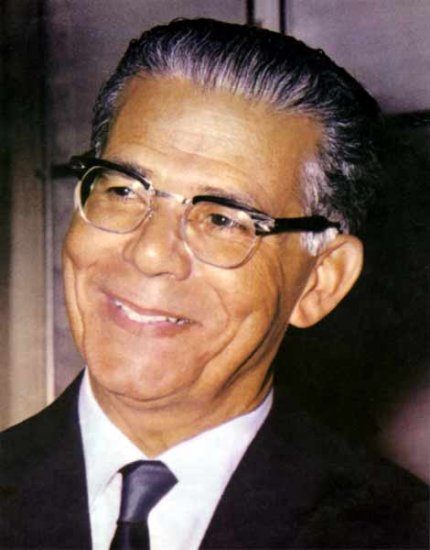
Joaquín Antonio Balaguer Ricardo was born on September 1, 1906, in Villa Bisonó, Santiago Province, Dominican Republic. He pursued higher education at the University of Santo Domingo, earning a law degree, and furthered his studies at the University of Paris. Balaguer's political career began in the 1930s, holding various diplomatic and governmental positions under the Trujillo regime, including Secretary of Education and Foreign Affairs. His close association with Trujillo positioned him as a prominent figure in Dominican politics.
First Presidency (1960–1962): Transitional Leadership
Following the resignation of President Héctor Trujillo in 1960, Balaguer assumed the presidency. His initial tenure was marked by attempts to liberalize the political climate, but he faced challenges from both Trujillo loyalists and opposition groups. The assassination of Rafael Trujillo in 1961 led to political instability, and Balaguer's efforts to maintain order were met with resistance. In 1962, under pressure from various factions, he resigned and went into exile.
Return to Power and "The Twelve Years" (1966–1978)
Balaguer returned to the Dominican Republic and won the presidency in 1966. His administration focused on economic development, infrastructure projects, and maintaining political stability. However, his governance was characterized by authoritarian practices, including suppression of dissent, censorship, and human rights abuses. Reports indicate that during this period, approximately 11,000 individuals were victims of political repression
Third Presidency (1986–1996): Infrastructure and Controversy
Balaguer returned to power in 1986, embarking on extensive infrastructure projects, including the construction of highways, schools, and hospitals. While these initiatives contributed to economic growth, his administration faced allegations of electoral fraud and continued human rights violations. The 1994 elections were particularly contentious, leading to political unrest and international scrutiny. In response to the crisis, Balaguer agreed to constitutional reforms and did not seek re-election in 1996.
Legacy and Impact
Balaguer's political career spanned over six decades, leaving a complex legacy. He is credited with modernizing the Dominican Republic's infrastructure and stabilizing its economy. However, his authoritarian rule, suppression of political opposition, and human rights abuses have been subjects of criticism. Balaguer passed away on July 14, 2002, at the age of 95.
Understanding Balaguer's tenure is essential to grasp the historical context that shapes contemporary Dominican politics. His governance style and policies continue to influence political discourse and development strategies in the country.